



If we can consciously use this routine to solve problems, it can not only allow us to move from worries to true thinking, but also continuously improve and integrate our way of thinking and knowledge system.

1 Your troubles are all because you can't think
I recently talked to a friend who works in sales. He used to work on process improvement within the company and achieved good results. Later, the leader thought he was a talented person and wanted to train him to become a manager, so they transferred him to sales to gain experience for a period of time.
However, he has been in sales for almost half a year and has not signed any contracts yet.
His boss began to be very dissatisfied with this, thinking that everything he did was wrong and often criticizing him in public. His confidence has also been greatly affected, and he has a huge psychological barrier every day at work, often suffering from insomnia all night.
However, after months of troubles, he still couldn't come up with any solution and felt hopeless in life.
Similar to his troubles, we all have: lack of career development prospects and confusion; The performance is always average and very disappointing; The customer's request cannot be met, which is very helpless; The boss doesn't recognize himself and is very frustrated; Unable to afford a house, very frustrated; Emotional problems are very painful
However, troubles are just troubles. Problems that linger in our minds for a year will not be solved, but will instead consume our time in endless entanglements and troubles. Stepping in place for too long not only fails to reach the finish line, but also exhausts oneself.
The effective method is to enter into genuine thinking and gradually approach the solution to the problem. But you may feel that solving the problem is very difficult?
Not at all.
Imagine if your air conditioner is broken, how did the repairman solve it?
Firstly, he will clarify with you where the problem lies, such as loud noise, lack of cooling, or something else. Then, based on his understanding of the structure of the air conditioner, he identified the possible faulty parts and conducted a thorough investigation to determine which part was the problem. Finally, he repaired them.
Extracting the methods for repairing air conditioning is actually the steps we are going to talk about today to solve the problem: clarifying the problem, analyzing the problem, proposing hypotheses, verifying and validating, and solving the problem.
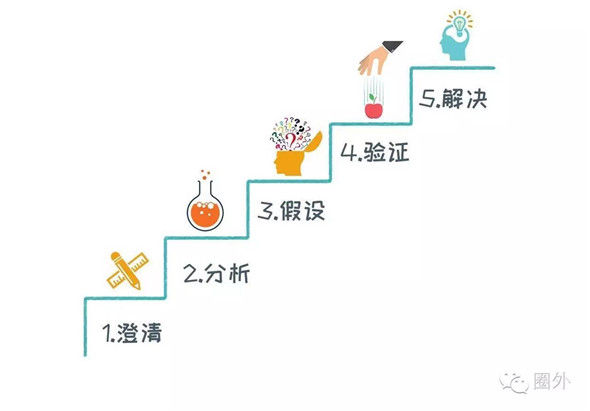
This is a very useful problem-solving technique. The vast majority of problems you encounter in your work and life can be solved using this routine.
Next, in response to the confusion of the salesperson we mentioned earlier, we will use the routine of repairing the air conditioner to solve his problem.
2 To solve the problem, only these 5 steps are needed
1. Clarification: Clarify the problem to be solved
What is the problem?
Let's first review the several issues mentioned above: lack of career development prospects, mediocre performance, inability to meet customer demands, lack of recognition from the boss, inability to afford a house, emotional problems
What are the commonalities among these?
They are all: there is a difference between the current situation and expectations.
So, all of our problems arise from the difference between the current situation and expectations, as shown in the following picture

If we cannot solve it, there will always be a gap between the two; But looking at it from a different perspective, what if we solve it? That can help us meet our expectations.
That is to say, the so-called problem, you can say it is an obstacle, but at the same time it is also an opportunity, an opportunity for us to move forward.
So, when clarifying a problem, the key is to find the current situation and expectations. If these two points are found correctly, the problem is almost solved.
However, there is still a difficulty here, which is that we often have more than one problem.
For example, in the case of a salesperson, he actually faces several problems: the boss's attitude towards him is not good, he cannot sign orders for a long time, he lacks confidence, suffers from insomnia, and has psychological barriers when going to work.
Many times, we are constantly troubled and unable to find a solution to a problem, often because a bunch of problems are mixed together, interrelated but not completely overlapping, looking like a tangled pile of threads that cannot be sorted out.
So, my suggestion is: solve only one problem at a time!
Trying to solve all problems at once is not a wise choice: firstly, our energy is limited and it is unlikely to solve all of them. Having too many problems can actually make us lose confidence in solving them; Secondly, having too many questions can make your thinking more confused; Thirdly, these problems are actually interrelated and interrelated, and solving one often solves the other.
So which one should we solve first? For example, the salesperson encountered five problems.
When screening problems, we can think about it this way: Is it possible that solving one of the problems will solve most of the other problems?
After analysis, the above five problems actually form a vicious cycle: if one cannot sign the contract for a long time, the boss will have a bad attitude towards them, and then they will start to lose confidence, leading to psychological barriers at work. This long-term negative energy will start to cause insomnia, and because of lack of confidence and poor rest, they will be unable to think about problems, sign the contract even further, and the boss will continue to have a bad attitude
How to break this cycle? We will find that signing contracts is the key issue, because the boss had a good attitude towards him when his performance was good before, and his work status was also very good.
So, the real problem lies in signing the contract and doing our best to solve it, which can break this vicious cycle. However, if we focus our efforts on other aspects, such as treating insomnia or confronting the boss, at most we can only treat the symptoms without addressing the root cause.
2. Analysis: Analyze the possible causes of the problem
Since signing the contract is a problem we need to solve immediately, let's start analyzing the reasons why we cannot sign the contract.
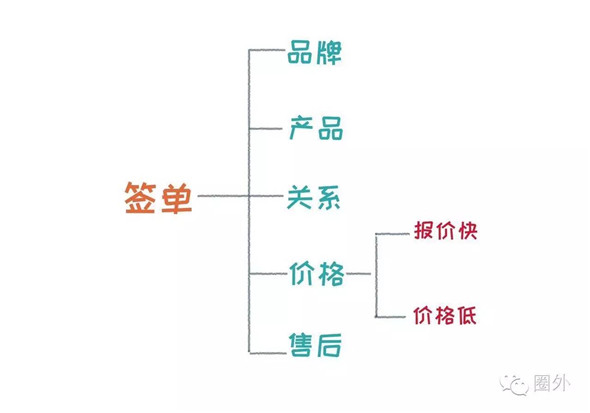
So, the question I asked him was: What are the key factors for achieving successful signing? Or, what is the decision-making basis for customers when signing contracts?
We have sorted out 5 elements together, among which "price" is considered the most important factor by her, so we have further subdivided it. The analysis results are shown in the following figure
3. Assumption: Among all possible reasons, assume the most likely one or several
My next question is: Among these factors, what is currently the biggest obstacle, or rather the most critical factor? He believes that the biggest problem with signing contracts is that our prices are too high.
Because every time the customer says, 'Your quote is too expensive, XX company only has half the price. If you can't achieve this price, there's no need to negotiate.'.
So, 'low price' is the most crucial factor he assumes.
When he reached this point of analysis, he began to feel discouraged again: price is the most important thing, but it is not my decision at all, so I cannot solve this problem at all. This is the reason why I have been troubled for several months before!
Is that really the case? In fact, this step is a pit that many people will fall into. I have previously stated in an article that the inability to define problems correctly results in most of us wasting 80% of our time.
In fact, the claims made by most customers that "competitors have lower prices than you" may not necessarily be true. The so-called "if the price is so high, I won't choose you again" is more likely to be a price cutting strategy.
Think carefully, when you go shopping and bargain, isn't that what you said? So, judging that this is the problem with just one sentence from the customer is likely to mislead oneself and result in wasted effort.
So, how to determine if 'low price' is the only determining factor? We still need the next step to verify your hypothesis.
4. Verification: Verify the previous hypothesis through data, facts, and other methods to identify the true reason
I asked him nine questions from three perspectives to help him verify or question whether price is the determining factor.
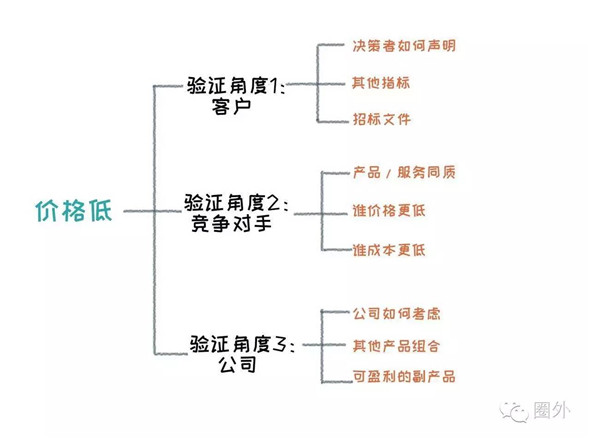
These three perspectives are customers, competitors, and companies. Let's go through this list of questions to help us understand what hypothesis testing is.
From the customer's perspective, what I need to question is:
Firstly, the customer claims that they only choose low-priced products. So, who on the customer side is saying this? We know that when you deal with a company, the customer is not one person, but several people in different positions. Some are the ones who make the final decision, some are responsible for negotiating prices, and some are the ones who ultimately use the product. The different positions of these people determine their different positions.
The person who talks to you about the price, their responsibility is to negotiate the price, of course they will say so, but does the highest decision-maker who ultimately bears full responsibility also think so? It is worth discussing.
Secondly, does the quality of the product and after-sales service really have no impact on the customer company? If there is an impact, they will inevitably not only focus on the price.
Thirdly, since it is a bidding process, there must be bidding documents. Does the document also state that only the price is considered? If not, what other factors are there?
After asking these three questions, he has already questioned his own judgment. So, from the perspective of competitors, we will continue to question:
Firstly, are we completely homogeneous with our competitors' products and services? Because we know that the more homogeneous the product, the more intense the price competition, so this is an important validation.
Secondly, are the prices of our competitors lower than ours? Since it's a price war, and since we can't sign orders every time, it means that our competitors always offer lower prices than us in order to ultimately win. So, is that right?
Thirdly, are the costs of competitors lower than ours? If their prices are indeed lower than ours every time, then how is their cost structure different from ours to be able to do so low?
Finally, there are three questions from the company's perspective:
Firstly, if this industry is really just about price competition, why should companies, as industry leaders, enter such a market?
Secondly, does the company have any by-products that can generate profits, which is why it entered this unprofitable field?
Thirdly, can this channel achieve a 1+1>2 effect compared to other channels of the company?
The three questions from the company's perspective actually force him to elevate his thinking height. For frontline sales, if you know the company's strategy, you can actually help yourself choose the customers the company needs and obtain the resources to achieve performance.
On the contrary, if one knows nothing about it, they will also do a lot of useless work.
After answering these nine questions, he finally admitted that price is not the only determining factor, at least not all customers think so. At the same time, the people I deal with on a daily basis are not the decision-makers who ultimately bear the responsibility.
Then, we used the above method to verify several other causal hypotheses. In the end, the real and important reason for not being able to sign the contract was identified:
1) Not selecting the right customers: The company's competitive advantage lies in the quality of its products and services, but it has not screened its customers, resulting in being caught in many situations
Small companies that value price spend too much time without producing any output
2) Decision maker not found: When communicating with clients, the person who truly bears the final decision-making responsibility was not found, and the communication targets were all low-level personnel whose main responsibility is to negotiate prices
3) Not actively seeking resources: targeting strategic users, not striving for company resource support, attempting to win orders through personal heroism
5. Solution: Based on the identified reasons, propose, screen, and determine the final solution
After identifying the problem, the proposal of a solution became a natural progression.
His final plan includes: firstly, based on the company's strengths, weaknesses, and development direction, he will develop his own criteria for screening customers and focus his maximum energy on the customers who are most likely to close deals;
Secondly, communicate with the true decision-makers on the customer side through various means, while telling them stories and emphasizing the consequences of solely focusing on price and using inferior products and services from competitors;
Thirdly, customers who have a positive impact on the company's strategy should request corresponding resources from the company when needed and be brave enough to seek help from their superiors.
Of course, the solution to this problem is relatively easy. Sometimes, we have multiple solutions at the same time that cannot be implemented simultaneously, which involves screening.
At this point, you can use a scoring table to identify the factors that you consider when screening solutions (such as feasibility, resolution, etc.), assign them weights, and weight each solution to give a weighted score, as shown in the following figure:
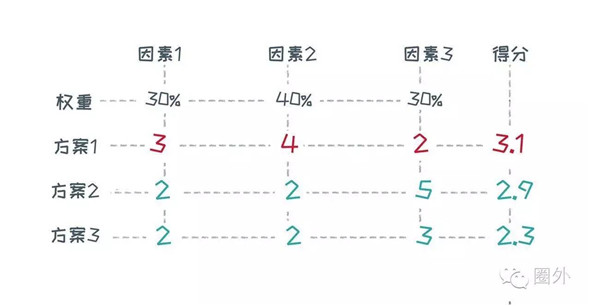
This scoring table can not only be used to screen solutions to problems, but also to make decisions when faced with choices.
So, after these five steps, the salesperson's problem was solved.
Is the process easy? be prone to. But did we do it? I can't do it.
Because solving problems is actually a comprehensive ability:
Firstly, when we are trapped by problems, we need the ability to regulate our emotions, allowing us to view them as opportunities and let go
Open up emotions and engage in rational thinking. So, for this step, we need emotional intelligence.
Secondly, when analyzing problems, structured thinking is needed to provide us with an analytical framework or structure. So, for this step, we need structured thinking.
Thirdly, when proposing hypotheses, we need to have some experience in this field. If we have no concept at all and cannot come up with hypotheses, we need to verify all possible reasons, which will take a lot of time.
Fourthly, when verifying hypotheses, we need to have critical thinking to question the hypotheses we just proposed.
Fifthly, when proposing solutions, if the problem is complex, we also need to have a level of thinking and be able to come up with solutions
There are often innovative solutions.
In fact, solving problems is the activity that can mobilize all of our thinking. All of our thinking abilities, knowledge, and experience are comprehensively reflected in problem-solving.
So, while we train our thinking and acquire knowledge, if we can consciously use this routine to solve problems, it can not only allow us to move from troubles to true thinking, but also continuously improve and integrate our way of thinking and knowledge system.
In my previous article on building a knowledge system, I mentioned that to integrate knowledge into a system, it is also necessary to solve problems.
After reading this article, why not choose a problem you have been facing recently and solve it according to the ideas I have proposed.
Record Number:Su ICP No. 2025223742-1
Sheyang Tianyuan Chemical Co., Ltd Copyright(C)2017 Network Support 思科网络 Copyright Statement Sitemap