


Sheyang Tianyuan Chemical Co., Ltd. Technical Center
(Sheyang Tianyuan Chemical Co., Ltd., Jiangsu Sheyang 224300)
Abstract: When directly using acidic dyes to dye nylon/spandex blended fabrics, it is easy to cause uneven dyeing and result in the phenomenon of "exposed white" on the fabric. Adding spandex coloring agent TY-AN can effectively solve this problem. Relaxing the fabric before dyeing, and then dyeing it with acidic dyes, can effectively eliminate the wrinkling phenomenon of elastic fabrics in the subsequent dyeing process. When the amount of AN added is 2g/L, the color difference between the two fibers is the smallest, the colors are basically consistent, and AN has little effect on the color fastness of the fabric, with a color fastness of level 4 or above.
Keywords: spandex coloring agent; Acid dyes; Nylon; spandex
Spandex has outstanding elastic properties. At present, most of the fashionable underwear on the market is made of nylon/spandex blends. Nylon fabrics containing spandex components are comfortable to wear and have extremely low wrinkle effects, making them popular among customers of swimsuits, underwear, and sportswear. However, due to the completely different chemical structures of these two types of fibers, if only acidic dyes that are beneficial for nylon coloring are used alone, it will cause the spandex fibers to show "whitening" phenomenon [2], that is, the spandex fibers are dyed unevenly, and dispersed dyes need to be added in combination with acidic dyes for dyeing to obtain a uniform color. However, currently the dispersed dyes on the market are mainly suitable for dyeing polyester, which is easy to desorb on spandex. At the same time, in order to prevent the dispersed dyes from staining on spandex, anti staining agents need to be specially added to improve the color fastness of the product, so the process is very complex. There are two methods to solve the above problems. One is to modify the structure of ordinary spandex fibers to make them easier to dye. However, this method still has some distance to go before it becomes feasible in reality. Secondly, by adding additives, spandex/nylon can achieve the closest color under acidic dyeing. This experiment chooses the second method, using a newly developed spandex coloring agent to study the dyeing of nylon/spandex fabrics, in order to solve the problem of uneven dyeing of spandex/nylon blended fabrics mentioned above.
1 Experiment
1.1 Materials
100% nylon fabric 4.4tex (40D), 100% spandex fabric 4.4tex (40D), 80/20 nylon/spandex blend fabric 4.4tex (40D)+4.4tex (40D), spandex coloring agent TY-AN (Sheyang Tianyuan Chemical Co., Ltd.), acid leveling agent, glacial acetic acid (commercially available), acid black M-R, acid bright red N-GS, acid navy blue N-R (Yorkshire Chemical Group Co., Ltd.)
1.2 Equipment
Analytical balance (Shanghai Precision Scientific Instrument Co., Ltd.), digital display air drying oven (Shanghai Xinnuo Instrument Factory), computerized colorimeter (Shanghai Jiaen Technology), SW-12A type II wash fastness tester (Nantong Hongda Experimental Instrument Co., Ltd.), Y571B dyeing friction fastness tester, YG-631 sweat bond fastness tester (Wuxi Textile Instrument Factory).
1.3 Relaxation treatment of fabrics
Heat set the elastic fabric containing spandex at 180-190 ℃ for 50 seconds.
1.4 Dyeing process
Acidic Black M-R 4%
Acidic leveling agent FTS 1g/L
Spandex colorant AN 0.2~2g/L
Glacial acetic acid 0.5g/L
Bath ratio 1:10
Temperature 98 ℃, 45 minutes
Add spandex coloring agent AN to the dye bath, heat up to 50 ℃, and immerse the fabric in the treatment for 20 minutes. Adjust the pH to 4.5-7.0 according to the type of acidic dye, add the dissolved dye, slowly heat up to 85-90 ℃, hold for 50 minutes, wash with water and take samples for color matching.
1.5 Color fastness test [4]
(1) The color fastness to soap washing is determined according to AATCC61.2A-2003 "Color Fastness to Water Washing".
(2) The color fastness to friction is determined according to GB/T3920-1997 "Color Fastness to Friction".
(3) The color fastness to sweat stains is determined according to ISO.105-E04 "Color fastness to sweat stains".
2 Results and Discussion
2.1 The effect of relaxation methods on fabrics
Due to the stress applied to elastic fabrics containing spandex, it is easy to cause uneven processing during dyeing and finishing. So before dyeing, relaxation treatment should be carried out to eliminate stress. At present, printing and dyeing enterprises can mainly relax and shape elastic fabrics through steam treatment, hot water treatment, dry heat treatment, solvent treatment and other methods, among which dry heat shaping has the strongest effect on elastic fabrics. When the temperature is above 150 ℃, the hydrogen bonds of spandex only open, but when it is above 200 ℃, spandex has already started to melt, so it is better to set at 180-190 ℃ for 50 seconds.
2.2 The influence of acid dyes on coloring different fabrics
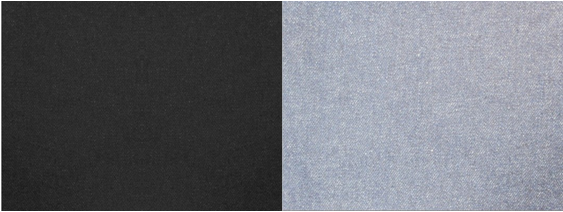
Taking acid black M-R dye as an example, after using the acid dye dyeing process to dye 100% nylon, 100% spandex, and fabrics, the dyeing effect is shown in Figure 1. When AN is not used, acid dye has a good dyeing effect on 100% nylon fabrics. This is mainly because acidic dyes contain anionic polar groups such as sulfonic acid groups, while nylon fibers contain a large amount of - NH2+ions. Therefore, acidic dyes can not only bind with nylon fibers through van der Waals forces, but also effectively bind in the form of ionic bonds [5], allowing acidic dyes to effectively dye nylon. When acid dyes are used to dye spandex, due to the chemical structure of spandex fibers being composed of a large number of urethane groups, their binding strength with acid dyes is low, resulting in poor fastness and extremely low dye uptake rate.
![RY5`1L]VKH[5XO9L7YMUERW.png](/ueditor/php/upload/image/20251125/1764074472939288.png "1764074472939288.png")
100%nylon 100%spandex
Figure 1 Dyeing effect of acid black M-R on two different fabrics
2.3 The influence of spandex coloring agent AN on the dyeing effect of spandex fabrics
After adding different amounts of AN treatment, taking Acid Black M-R as an example, the dyeing effect of 100% spandex fabric is shown in Figure 2, after using AN. Due to the ability of AN to form water-soluble complexes with acidic dyes, it can effectively penetrate the dye into the interior of spandex fibers, thereby improving the dye uptake rate. When AN is added at 2g/L, the dye uptake effect of spandex fabric is relatively uniform.
1g/L 2g/L
Figure 2 Effect of AN on dyeing effect of 100% spandex fabric
2.4 The influence of spandex coloring agent AN on the dyeing effect of nylon/spandex fabrics
When AN is not used, it is easy to experience "whitening" on nylon/spandex blended fabrics after acid black M-R treatment. This is due to the poor dyeing effect of acid dyes on spandex, resulting in uneven dyeing of the blended fabric after washing. The dyeing effect of AN addition on different proportions of nylon/spandex fabrics is shown in Table 1. Taking Acid Black M-R as an example, with the increase of AN addition, the dyeing effect of nylon is basically not affected, while the dyeing effect of spandex is significantly increased. When the AN addition is 2g/L, the color difference between the two fibers is the smallest, and the color of spandex and nylon is basically the same.
Table 1 Effect of AN dosage on the △ E of two components in nylon/spandex mixed fabric
AN dosage/(g · L-1) | Nylon K/S value | K/S value of spandex | Color difference value △ E |
0 | 6.45 | 1.65 | 6.21 |
0.5 | 6.45 | 3.45 | 4.56 |
1.0 | 6.46 | 4.88 | 3.88 |
1.5 | 6.45 | 5.76 | 2.17 |
2.0 | 6.46 | 6.51 | 1.75 |
2.5 | 6.45 | 6.77 | 1.84 |
As shown in Figure 3, when the AN addition amount is 2g/L, the "whitening" phenomenon basically disappears, indicating that spandex and nylon can obtain basically consistent colors after AN treatment.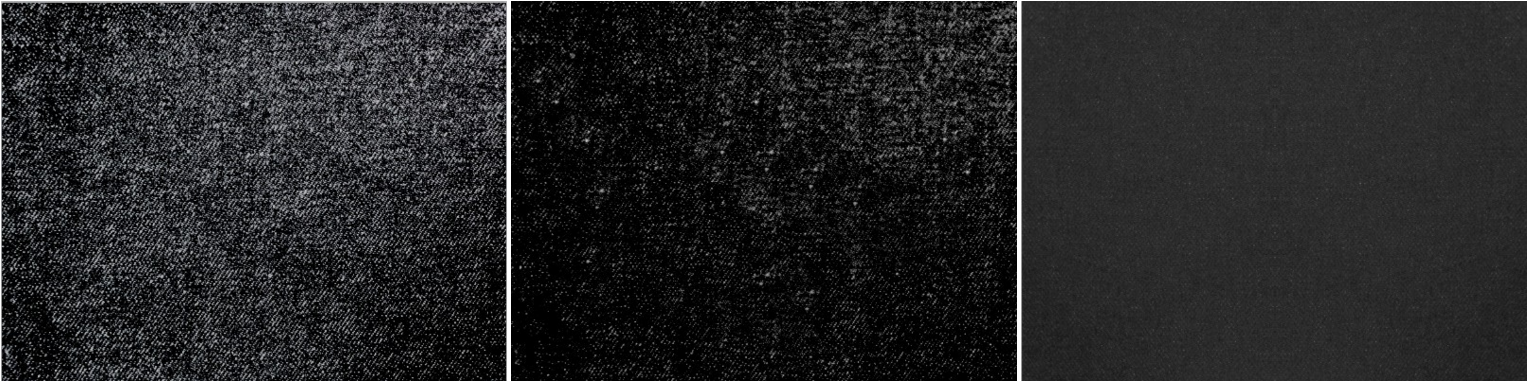
空白 1g/L 2g/L
Figure 3: The Effect of AN on Dyeing Nylon/Spandex Blended Fabric
2.5 Dyeing performance
According to the optimized process mentioned above, the nylon/spandex mixed fabric was dyed, and the K/S value, color difference value △ E, and various color fastness of nylon and spandex fibers were tested. The results are shown in Tables 2 and 3. From Tables 2 and 3, it can be seen that AN has good color consistency with nylon/spandex mixed fabrics, and the color fastness is generally above level 4.
Table 2 K/S values and color difference values △ E of nylon and spandex fibers
Type of dye | Fiber type | K/S value | Color difference value △ E |
Acidic Black M-R | nylon | 6.46 | — |
spandex | 6.51 | 1.75 | |
Acid Red N-GS | nylon | 6.58 | — |
spandex | 6.49 | 1.62 | |
Acidic Tibetan Blue N-R | nylon | 6.85 | — |
spandex | 6.88 | 1.49 |
Table 3 Color Fastness of Nylon/Spandex Blended Fabric
Type of dye | Soap washing fastness/grade | Sweat stain fastness/grade | Friction fastness/grade | |||
Staining color | fade | Staining color | fade | Staining color | fade | |
Acidic Black M-R | 5 | 4~5 | 4~5 | 4~5 | 4~5 | 4~5 |
Acid Red N-GS | 4~5 | 4~5 | 4~5 | 4~5 | 4~5 | 4~5 |
Acidic Tibetan Blue N-R | 4~5 | 4~5 | 4~5 | 4~5 | 4~5 | 4~5 |
3 Conclusion
(1) Relaxation treatment can effectively eliminate stress on elastic fabrics. Setting at 180-190 ℃ for 50 seconds can effectively eliminate wrinkles in elastic fabrics during subsequent dyeing processes.
(2) The use of spandex coloring agent can significantly improve the dyeing effect of acid dyes on spandex. When the AN dosage is 2g/L, the color of nylon/spandex mixed fabric is basically the same.
(3) After adopting AN, the color fastness of the fabric is basically not affected, and the color fastness is generally above level 4.
References:
[1] Fan Xuerong, Zhou Jinyun, etc The relationship between the structure and elastic characteristics of spandex fibers and the dyeing and finishing of spandex knitted elastic fabrics [J]. Journal of Textiles, 1994, (10):14-17.
[2] Wang Huizhen Exploration of Dye Structure and Dyeing Properties of Spandex [J]. Silk Thickening, 2002 (7), 12-14
[3] Qianjiang Fei Research on the Same Color Dyeing of Dispersed Dyes for Spandex/Nylon Composite Silk [J]. Printing and Dyeing, 2000 (8), 5-7+11-2
[4] Tang Junsong, Zhang Jianguo, Li Xinpeng, etc Dyeing and Finishing Processing of Polyester Brocade Interwoven Cool Fabric [J]. Printing and Dyeing 2013, 39 (5): 21-24
[5] Zhao Tao Dyeing and Finishing Processes and Principles [M]. Beijing: China Textile Press
Record Number:Su ICP No. 2025223742-1
Sheyang Tianyuan Chemical Co., Ltd Copyright(C)2017 Network Support 思科网络 Copyright Statement Sitemap